
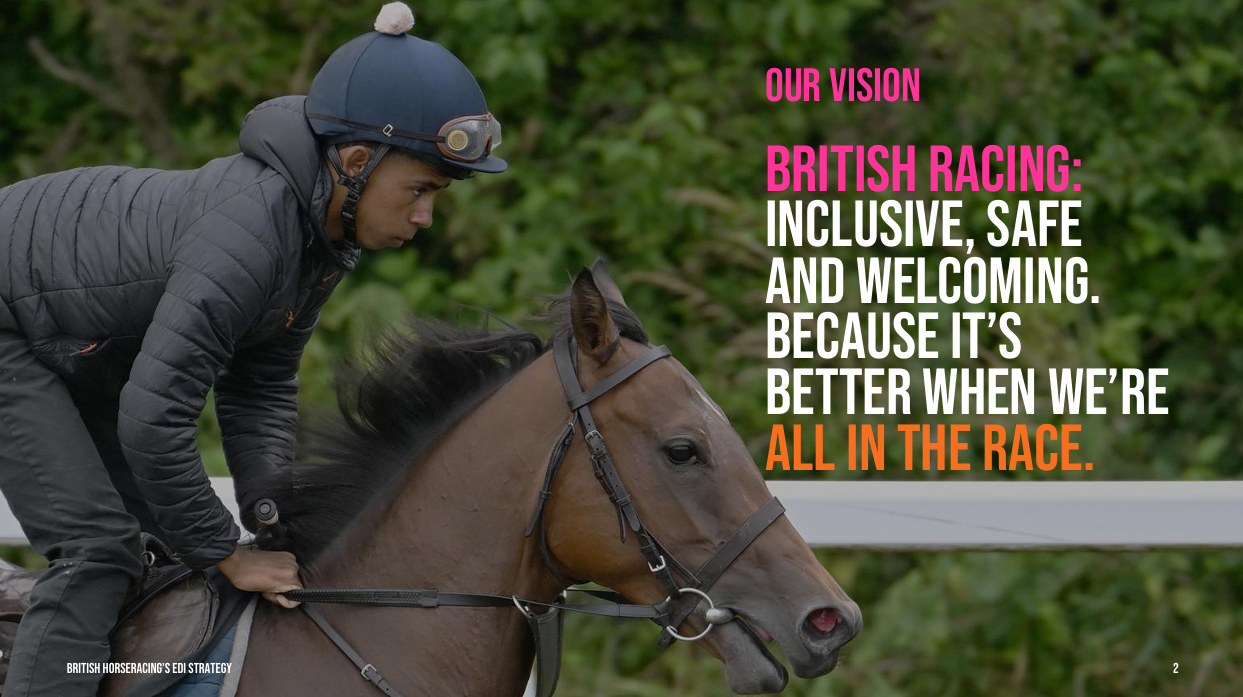
- Three‑year framework sets clear actions to strengthen leadership, improve fairness, widen opportunity and engage new audiences.
- New ethnicity research published, providing evidence and lived experience that, alongside other research, has contributed to the strategy.
- Focus on practical change, including improved reporting systems, promoting and supporting employment best practice, expanded education and better support for underrepresented groups.
- Strategy emphasises shared responsibility across the sport, recognising progress to date while calling for collective action to secure racing’s long‑term sustainability.
The British Horseracing Authority (BHA) has today announced the launch of All in the Race, a new Equality, Diversity and Inclusion Strategy designed to ensure British racing is an inclusive, safe and welcoming sport for everyone.
Alongside the strategy, the BHA has also published a summary of new research into the experiences of ethnically and culturally diverse people working within the sport.
Together, these publications set out a clear, evidence-based framework for action across the next three years. They aim to strengthen leadership, improve fairness and safety, widen opportunity, and ensure racing remains relevant and competitive in modern Britain.
The strategy is centrally led by the BHA but collectively owned by the sport. It has been developed in collaboration with the sport’s core stakeholders and participants, as well as the Diversity in Racing Advisory Group. It provides direction, standards and accountability, while recognising that meaningful progress depends on collaboration across leaders, racecourses, jockeys, owners, breeders, trainers, charities and the wider workforce.
The strategy outlines a vision for a sport where everyone feels respected, valued and able to fulfil their potential. It emphasises that making sure that all people feel welcome and included is essential to racing’s long-term sustainability. It is based on evidence and the experiences of racing’s workforce, many of whom have positive experiences, but not all.
Key drivers include:
- Workforce sustainability – attracting and retaining the people racing needs to thrive.
- Relevance to modern Britain – ensuring the sport reflects and appeals to a broader range of communities.
- Reputational resilience – meeting the expectations of fans, media, investors and policymakers.
- Commercial advantage – stronger performance, innovation and audience growth through greater diversity.
The strategy builds on significant progress already made across the sport, including new inclusive career pathways, safeguarding and anti-sexual misconduct training, and the work of racing charities and community groups. However, it also acknowledges that progress has been uneven and that some people have not always felt welcome or supported.
The development of the strategy, and some of the recommendations within it, have been drawn from the sport’s workforce strategy, published by the Horseracing Industry People Board in February 2025.
The strategy sets out clear, measurable actions that will make a tangible difference to day-to-day experiences across the sport for people across the full spectrum of protected characteristics. These actions include:
- Strengthening leadership and accountability
- Building more diverse viewpoints into decision-making.
- Sharing and celebrating best practice.
- Refreshing and auditing the D&I Industry Commitment.
- Building equitable practices
- Supporting the future development of an Employer Quality Standard to promote best practice.
- Improving and simplifying reporting mechanisms for discrimination, including an improved and more responsive system for people to anonymously share concerns (still branded RaceWISE) launching in the coming weeks
- Improving race day facilities and accessibility for jockeys
- Improving education and awareness
- Expanding inclusion training for high-impact roles.
- Launching a visual awareness campaign promoting positive behaviours and challenging discrimination.
- Introducing continuous learning for senior leaders and Boards.
- Better supporting and celebrating underrepresented groups
- Targeted actions to support ethnically and culturally diverse colleagues, including language support.
- Removing barriers for female and ethnically diverse jockeys through the Rider Development Pathway and Racing Home.
- Launching a Leadership Development Programme for underrepresented groups.
- Engaging new audiences
- Embedding diversity objectives into consumer engagement and social impact initiatives.
- Building partnerships to diversify early careers programmes.
- Providing best practice guidance on inclusive marketing.
These actions will be delivered through a phased implementation plan running to 2028, with transparent reporting and regular review.
The accompanying ethnicity research summary draws on three independent studies conducted between 2023 and 2025. While many people from ethnically and culturally diverse backgrounds report positive experiences in racing, the research also highlights negative experiences, barriers to progression (which are often hidden), inconsistent support, and a lack of trust in reporting systems. We are grateful to all research participants for their contribution.
These findings have helped contribute to the new strategy and will inform a dedicated ethnic and cultural diversity action plan to be developed with industry leaders and people with lived experience.
The strategy has been launched with support from industry stakeholders including the National Association of Racing Staff (NARS), National Trainers Federation (NTF), Professional Jockeys Association (PJA), Racecourse Association (RCA), Racehorse Owners Association (ROA) and Thoroughbred Breeders Association (TBA).
It has also been developed with collaboration from racing’s various industry charities which support various diverse groups within the industry.
QUOTES
Brant Dunshea, Chief Executive of the BHA said:
“British racing is at its best when it is open, welcoming and reflective of the society around us. This strategy about the long-term health and success of our sport. To attract talent, fans and investment, we must ensure that everyone who works in or engages with racing feels safe, respected and able to thrive.
“It is about everyone in our sport, from racecourses to yards to studs and schools, governing bodies and beyond.
“We are proud of the progress already made across the industry, but we are also honest about where more work is needed. The research the sport has carried out here and in the past has helped us recognise and accept where there is a problem, and act on it.
David Jones, Senior Independent Director for the BHA, said:
“This strategy provides a clear, practical framework for action and a long-term ambition to create a modern, inclusive culture supported by diverse and empowered leaders and a sport in which fans, participants and the workforce reflect modern Britain, where opportunities are equitable, and where discrimination is not tolerated. Its success will depend on leadership, accountability and collaboration across the whole sport.”
Rose Grissell, Head of Diversity and Inclusion for the BHA added:
“The strategy is rooted in evidence and shaped by the lived experiences of people working in racing today, and we offer a huge thank you to those who have taken the time and shown the courage to share these with us.
“Many have positive experiences, but not everyone does, and acknowledging that is an important step in supporting positive progress.
“Our aim is to make inclusion part of everyday practice, not an optional extra. That means equipping people with the tools, education and support they need, and ensuring that small, everyday behaviours contribute to a culture where everyone feels they belong”.
Julia Tyson, Chair of the Horseracing Industry People Board said:
“People are at the heart of British racing, and this strategy is essential to building a sustainable, skilled and motivated workforce for the future.
“The research makes clear that while there is much to celebrate, there are also barriers that prevent some people from progressing or feeling fully included. In some cases, for instance, this can lead to poor mental health and higher levels of sickness absence. Addressing these challenges is not only the right thing to do, but vital for the competitiveness and resilience of the sport.”
Josh Apiafi, Sky Sports Racing presenter, said:
“It should be celebrated that the sport has worked hard to produce this strategy, ensuring that at its core sits the experience, support, and development of racing’s family from ethnically diverse backgrounds.
“Once you are within racing’s fold, it is a welcoming sport. However, we have faced numerous barriers to entry that have prevented ethnically diverse communities from becoming part of racing’s fanbase and workforce.
“This strategy has the potential to significantly open employment pathways and create long-term opportunities that will support the future growth of the sport.
“It is the responsibility of all stakeholders across racing to ensure that Diversity and Inclusion remain front of mind, not only in principle, but in practice.”
Bobby Beevers, founder of Autism in Racing, said:
“We are proud to support the BHA’s Equality, Diversity and Inclusion strategy. People who are autistic and neurodiverse should always feel welcome within racing. Through Autism in Racing, we are ensuring that autistic voices are heard and represented across the industry. By working together, we can make the sport more inclusive so that everyone can enjoy racing, pursue careers within it, and truly feel they belong.”
Cheryl Caves, Chair of Women in Racing, who have published their new Racing Home: Menopause, Midlife and Well-being in British Horseracing report said:
“Women in Racing is pleased to support the new strategy. As an independent organisation we have an important role to play in the delivery of the strategy and our existing programmes, including industry-leading mentoring, bursaries and events will contribute to its success. Racing Home and our new menopause research demonstrate how by listening to, and working with the sport’s participants we can make racing a better environment for all”
David Letts, Chair of Racing with Pride, said:
“The launch of this strategy marks a significant step forward for British horseracing, providing a clear and unified framework for meaningful progress across the sport. While much positive work has already been undertaken, we now have the opportunity to bring those efforts together, ensuring the whole is greater than the sum of its parts.
“Importantly, the published research shines a light on the challenges still facing the sport – challenges which we must face head-on. I am proud to see a commitment that goes beyond words, with tangible actions outlined, to create a culture where everyone feels safe, valued and able to thrive within our industry.”
Notes to editors:
- Download All In The Race: British Horseracing’s Equality, Diversity and Inclusion Strategy
- British Horseracing’s Ethnic & cultural Diversity Research Summary
- Support lines
Mental Health Medical Emergency: Call 999 or go to A&E (call an ambulance or get someone to drive you)
Mental Health Urgent Support (non-life threatening): Call 111 Select Mental Health on the telephone options, The Samaritans call 116 123 (available 24/7)
For less urgent, industry Mental Health Support, contact Racing Welfare on 0800 6300 443
To share a concern: Contact RaceWISE.