
Equine Influenza: updated guidance
Earlier this week the decision was made to abandon Sunday’s fixture at Plumpton Racecourse, following a confirmed case of equine influenza and EHV-4 in a livery yard immediately adjacent to the racecourse.
The abandonment of the fixture was a precautionary measure, given the highly contagious nature of equine influenza, which is airborne over reasonable distances and can be transmitted indirectly, including via people.
The infected horse is an unvaccinated, non-thoroughbred. But with a confirmed case in such close proximity, this decision was unanimously supported by the BHA’s independent veterinary group to restrict any risk of onward transmission to the thoroughbred herd.
Rise in flu cases across the UK
The BHA recently published information for racehorse trainers, racing veterinarians and other stakeholders about several outbreaks of equine influenza across the UK, and there has since been a significant rise in the cases reported to the Equine Infectious Disease Surveillance (EIDS) team. The latest updates are available on the EIDS website.
These outbreaks are in the non-thoroughbred herd and there have been no reported cases or clinical signs in licensed training yards. Most of the reported cases are in non-vaccinated animals, but some cases have occurred in vaccinated horses. It is important to emphasise however that these are horses approaching the point of their next booster vaccination and therefore their immunity is lower.
All horses running in Britain must be vaccinated in line with the Rules of Racing, with booster jabs administered no more than six months apart.
Properly vaccinated horses have good protection and, while infection cannot always be prevented, vaccinations will reduce the severity and help horses recover more quickly, while spreading less virus so fewer horses get ill.
The signs of equine influenza
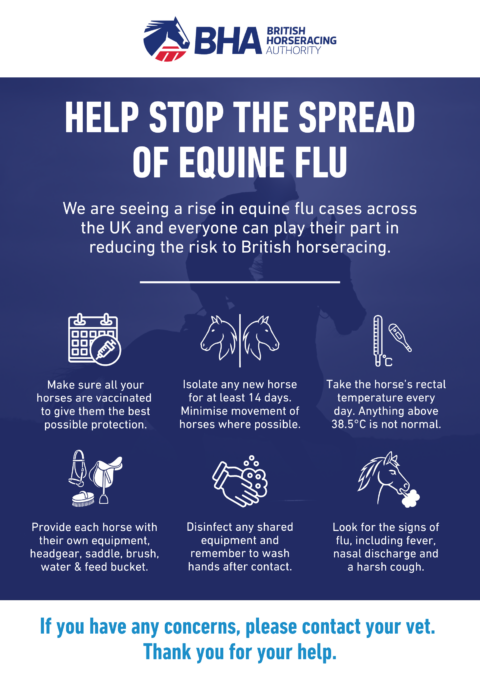
Click to download this infographic of the key steps you can take to reduce risk
Trainers should continue to be alert to the signs of infection, which include a raised temperature (above 38.5°C), a harsh cough or nasal discharge, and also things like lethargy and poor performance or loss of appetite.
Monitor all horses for clinical signs and record their rectal temperatures daily. If a horse is showing these signs or you have any concerns about their wellbeing, please consult your veterinary surgeon right away.
Any infected horse should be isolated until a veterinary surgeon advises otherwise. Please inform the BHA immediately about any confirmed or potential case.
Biosecurity measures to reduce risk
In addition to making sure all vaccinations are up to date, we continue to advise trainers to be extra vigilant with biosecurity on the yard, when travelling to the racecourse and in the racecourse stables.
Please exercise appropriate caution around the movement of both horses and people to and from your yard to minimise any risk and provide the best possible protection for your horses.
Equine influenza can be transmitted indirectly via people, so remind staff about your yard’s hygiene measures like regular hand washing, using designated equipment and disinfecting any shared equipment.
A substantial proportion of the outbreaks involve horses that have recently moved premises. Any new horse entering a yard should be fully vaccinated and isolated for a period of 14 days. Any signs of equine influenza should be assessed immediately by your vet.
More information and next steps
More information about the steps trainers and others can take to minimise risk and advice on what to do if you suspect flu is available on the EIDS website.
This includes links to resources for veterinary professionals, including the EIDS disease reporting platform, the Horserace Betting Levy Board (HBLB) flu surveillance scheme and Equiflunet.
We continue to monitor this situation closely, working with the EIDS and independent infectious disease experts, and will keep the British horseracing industry updated.
For any immediate questions, please contact: [email protected].