
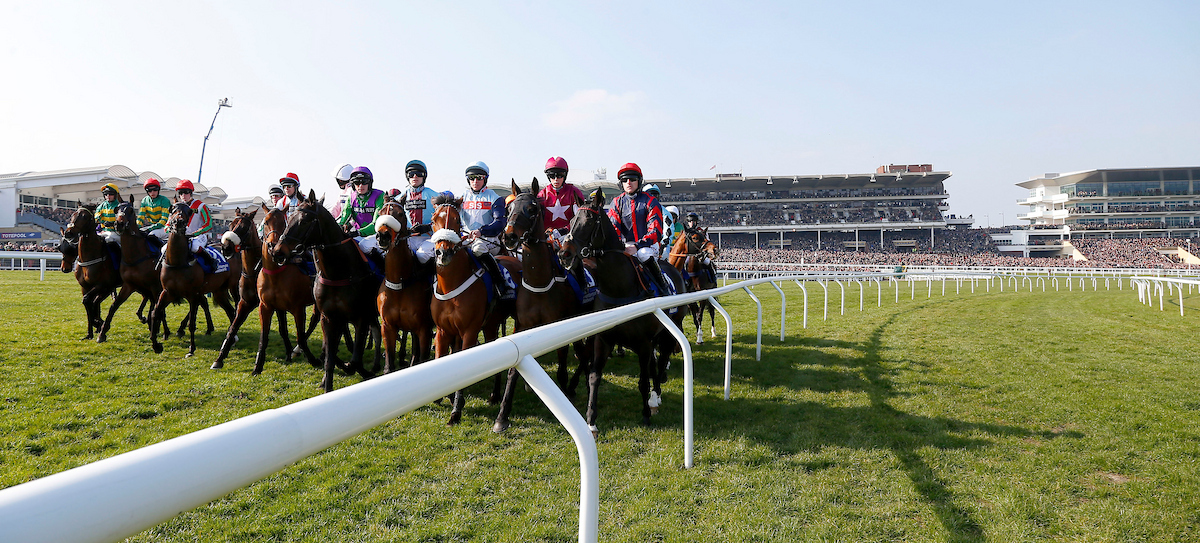
- Course configuration, starting procedure changes and enhanced regulation are among the recommendations
- Thorough review process included focus groups with jockeys, trainers, bettors, officials and broadcasters alongside a detailed review of data
- Recommendations include Cheltenham-specific layout changes alongside others which apply to Jump racing as a whole
The British Horseracing Authority (BHA) has today announced a series of recommendations for changes which are designed to improve the starts at both Cheltenham racecourse and across Jump racing in general.
The recommendations are the output of a detailed review into starts at the Cheltenham Festival which was announced following a significant, and rising, number of false starts at recent Festivals.
The review was carried out by the BHA alongside Cheltenham racecourse and included extensive consultation with jockeys from Britain and Ireland alongside trainers, bettors, broadcasters, officials and other stakeholders. It consisted of both in-person focus groups and written responses, alongside a detailed review of data and the racecourse layout.
Jockeys who participated in the process included the likes of Keith Donoghue, Liam Harrison, Jack Kennedy, Danny Mullins, Sean Quinlan, Gavin Sheehan, Harry Skelton, Mark Walsh and Tabitha Worsley among others, and we are grateful for the part played by everyone involved in this process.
The feedback gathered from this process identified a number of recurring themes. These included:
- Horses occasionally approach the start from too far back, particularly where starts occur on a bend.
- Course configuration was a dominant theme. Narrow holding pens, funnel effects, and specific problematic start locations were identified (notably the 2m and 2 ½m starts).
- The need for simplification and greater clarity and consistency in starting procedures, clearer communication between officials and jockeys, and increased starter discretion.
- That current rules are not being enforced rigorously enough, and the sanctions are not a sufficient deterrent, especially in more valuable or prestigious races.
A detailed analysis of data was also carried out. The findings of this included that:
- The percentage of races resulting in an aborted start at the Cheltenham Festival had increased annually over the last five years from around 18% in 2022 to nearly 40% in 2026.
- This is in stark contrast to wider jump racing where the rate has fluctuated between around 3% – 4% of starts over the same period.
- It also showed a clear trend that the 2m and 2 1/2m starts on both the Old and New course contributed a significant and disproportionate amount of false starts in relation to most other starting locations.
These findings, alongside other views expressed in the process, were considered by the BHA and Cheltenham racecourse, and the following recommendations have since been shared with industry stakeholders and approved by the BHA.
The recommendations include a combination of changes to the layout at Cheltenham racecourse, greater clarity in starting procedures and enhanced regulation and penalties. They have the objective of reducing the numbers of false starts and ensuring, as much as possible, a fair and even start for all participants.
Recommendations
- Optimise as far as possible the physical track layouts at Cheltenham’s two most problematic starting points (2 mile and 2 1/2 mile) to reduce natural field congestion and acceleration, within the confines of the topography of the land in these areas.
- To provide greater clarity for jockeys and more flexibility for starters, transition the current wording within the rules as to the maximum pace at which a horse can approach the tapes from a “walk or jig-jog” to “walking pace” to apply to all Jump races.
- To provide greater clarity for jockeys, officials and the viewing public, explore the concept of a physical, highly visible “start zone” at starts across all racecourses to create a zone in which a starter is able to start a race.
- To provide a greater deterrent against breaches of the rules at the start of major races, implement a tiered penalty increase specifically targeting Class 1 and Class 2 races across all courses, in the same manner as the whip rules.
- Introduce a live audio recording system at the start area to capture communications and instructions given by starters to jockeys, with a direct feed to the stewards’ room.
MORE DETAILS REGARDING THE RECOMMENDATIONS, RATIONALE AND NEXT STEPS CAN BE FOUND HERE.
The above remain, at this stage, as recommendations. Prior to any implementation all of these recommendations will now be scoped out in more detail. This includes further discussion with participants, assessment of racecourses where there are proposals for physical changes, and consideration of trial periods ahead of full implementation.
Cathy O’Meara, Head of Raceday Officials for the BHA, said:
“I want to thank everyone who took part in this review for the honesty and insight they brought to the process. Their feedback, combined with the detailed data analysis, has given us a clear picture of the recurring challenges at Cheltenham, particularly around course configuration, the approach to the tapes, and the need for greater clarity and consistency in starting procedures.
“Cheltenham is a unique environment. It is the pinnacle of Jump racing, with the intensity, atmosphere and significance of the meeting all contributing to the pressure at the start. Our starters do an excellent job in the toughest circumstances, and these recommendations are designed to support them and the jockeys, from improving the physical layout at the most problematic starts to simplifying the rules, enhancing communication, and strengthening regulation where needed.
“We hope these changes will lead to an improvement to starts at the Festival and across Jump racing. But they are not a golden bullet. Success also depends on everyone involved doing their part to observe the starting procedures. We will monitor how these measures bed in throughout 2027 and continue to refine them where necessary to ensure the best possible experience for horses, jockeys and racing fans.”
Jon Pullin, Clerk of the Course at Cheltenham Racecourse, said:
“We’ve worked closely both with participants and the BHA since this year’s Festival and have made a number of layout changes to the two and two and a half mile starts on both the old and new courses. We will be monitoring them closely as our season begins along with any other impacts of the wider proposed changes to starting procedures as they bed in.”
Dale Gibson, Executive Director (Racing) for the PJA, added:
“A smooth and fair start for all horses is important for everyone – jockeys, trainers, owners, racing staff, and those betting on the sport – and the PJA and our members were keen and active participants in the review as a result. We welcome the outcome of the review and the recommendations, many of which were proposed by senior riders and our safety officers, working with the racecourse and the BHA Course Inspectorate, and will continue to work closely with our members and the BHA on the remaining areas for consultation”.
A further area that was covered as part of the review was standing starts. While some participants expressed their dislike of standing starts it was felt that the current system, which includes the ability for two attempts at a walking start prior to reverting to a standing start, was the preferred option. This is due to the fact that, once two false starts have taken place it will become increasingly harder for starters and jockeys for a race to be started fairly, and therefore the addition of the standing starts ensures that there are only ever a maximum of three attempts to start any single race.
Notes to Editors
- MORE DETAILS REGARDING THE RECOMMENDATIONS, RATIONALE AND NEXT STEPS CAN BE FOUND HERE.
- Groups who participated in the consultation include:
- BHA officials and Racing Department
- Cheltenham racecourse
- Horserace Bettors Forum (HBF)
- Irish Horseracing Regulatory Board (IHRB)
- Irish Jockeys Association (IJA) and Irish jockeys
- ITV and RTV broadcasters
- National Trainers Federations (NTF) and trainers
- Professional Jockeys Association (PJA) and jockeys