
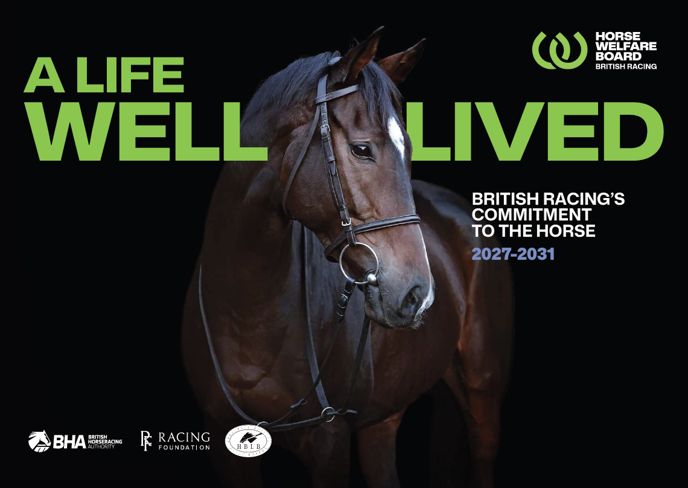
- Independent Horse Welfare Board’s new strategy sets out the next five years of welfare strategy across British racing
- 2027 – 2031 strategy sets out 20 priorities across Quality of Life, Safety, Lifetime Responsibility and Public Trust, with traceability a major focus
- Long-term ambition to achieve 100% lifetime traceability for Thoroughbreds bred for racing in Great Britain, with this strategy setting the groundwork for that target
- Traceability programme includes retirement and first-step-out-of-racing data, digital vaccination records, improved data sharing and modernisation of core systems
- Actions span safety and injury prevention, wellbeing, aftercare, data and technology, and increasing transparency
- Retraining of Racehorses will continue to lead aftercare with release of a new five-year plan
- 2027 strategy work fully supported with funding from the Racing Foundation and the Horserace Betting Levy Board
British racing has today launched its next five-year Horse Welfare Strategy setting out 20 priorities to drive further improvements in the welfare and safety of Thoroughbreds throughout their lives.
Launched at a parliamentary reception in Westminster, the British Horseracing Horse Welfare Strategy 2027–2031 builds on ‘A Life Well Lived’, the sport’s first industry-wide welfare strategy, published in 2020, and sets the direction for the next phase of welfare action across racing.
The strategy is structured around four outcomes – Quality of Life, Safety, Lifetime Responsibility and Trust – spanning areas including veterinary research, injury prevention, the training environment, aftercare, data and technology, governance, transparency and public confidence.
A major focus within the new strategy is ‘traceability’ – the movement and tracking of horses bred for the sport, before during and after their racing careers.
The Horse Welfare Board has set an ambition to achieve 100% lifetime traceability for Thoroughbreds bred for racing in Great Britain, creating a more connected picture of each horse’s journey from birth, through racing and into retirement and potential second careers. Building on the existing 100% traceability achieved during a horse’s racing career, the strategy aims to strengthen and improve additional data and information points to extend visibility beyond their racing career and throughout each horse’s lifetime.
The sport’s official aftercare partner, Retraining of Racehorses, will continue to lead the work in the aftercare sector, with its new five-year strategy, also published today outlining the priority areas of improving visibility and traceability; strengthening welfare, education and lifelong support; increasing participation and demand for former racehorses; and securing the funding and organisational resilience needed to deliver lasting change, alongside working in partnership with the Horse Welfare Board on the collective objective to improve traceability.
Traceability underpins the strategy’s commitment to Lifetime Responsibility. Better information about where horses are throughout their lives can strengthen welfare oversight and accountability, improve understanding of outcomes and welfare interventions, and support biosecurity and disease preparedness.
The strategy will build on work previously undertaken as a result of A Life Well Lived and resulting projects such as the Horse Welfare Board’s 2023 Thoroughbred Census and the Thoroughbred Breeders Association’s analysis of pathways taken by British-bred foals to improve lifecycle and outcome data.
View the strategy launch video here:
Work has been driven by a cross-industry team with representatives involved in all stages of a horse’s life, informing the strategy and the ambition it sets out to develop a digital traceability solution.
It also sets out an ambition to work with government and the wider equine sector to explore a practical, scalable model that could strengthen traceability, welfare, biosecurity and transparency beyond racing.
Planned actions include strengthening traceability at the first step out of racing; data sharing with other equestrian disciplines; increasing the use of digital vaccination records; improving national and international data sharing; and enhancing core systems such as the General Stud Book. And where legislation is needed to help close those gaps, racing – along with the wider equine sector – will be prepared to make that case to Government.
Baroness Minette Batters, Chair of the Horse Welfare Board, said:
“Our launch of A Life Well Lived sets out an ambition to lead the world on Horse Welfare. We have made important progress in recent years, but welfare can never be an area where we stand still.
“Our responsibility is not simply to establish good welfare standards and maintain them. But to be able to continue to optimise and measure tangible benefits for our racehorses.
“One of the clearest examples of that lifetime responsibility is traceability. If we are serious about taking responsibility for our horses throughout their lives, we need to know where they are. That is why our ambition is 100% lifetime traceability for Thoroughbreds bred for racing in Great Britain.
“But our ambition doesn’t stop there, because there is an opportunity for all horses and ponies beyond racing. I believe racing can help develop a traceability blueprint which will aim to transform the horse welfare requirements of every horse and pony in this country – starting by simply knowing where they are.
“And traceability is one part of a much wider programme. Across quality of life, safety, lifetime responsibility and trust, this strategy sets out where we need to keep learning, use evidence and technology more effectively, be transparent and accountable, and work together as a sport to deliver meaningful and measurable improvement”.
Expanding safety beyond the racecourse
Alongside a continued focus on improving safety on the race track a significant development in the new strategy is the expansion of efforts to identify and reduce risks originating from the training environment or other areas of a horse’s life.
The aim is to build a more complete evidence base around a horse’s life away from the racecourse and how this may contribute to safety. Key to this will be improving data from the training environment – including medication and clinical data, the surfaces horses train on, workloads, injuries and breaks in training – and how these factors may help to identify and reduce risk earlier.
The strategy will also explore how AI, wearable technology and developments in equine data collection and analysis can help build our evidence-base and to ultimately predict and prevent risk, before it can occur. And our safety work will look further upstream too – at breeding, early years and pre-training, to ensure we breed and prepare horses resilient and ready to take on the race.
Quality of Life
As part of an enhanced focus on horses’ physical and mental wellbeing, the BHA has added its name as signatories to the British Equestrian Federation’s “Charter for the Horse” which sets out a unified approach to equine welfare, wellbeing and ethics across the equine industry. Further, British racing has developed its own “Commitment to the Horse” which adopts the concepts from the Charter and applies them to the Racing industry as an aspirational set of values.
Brant Dunshea, Chief Executive of the British Horseracing Authority, said:
“Horseracing is the second most popular sport in the country, contributing £4.1 billion every year to our economy and employing over 85,000 people across the industry. But horseracing is also about the unique relationship between horses and people.
“This strategy is important because it reflects a simple principle – we are accountable for every horse that is bred for racing and that accountability extends throughout our horses’ lives. That responsibility is central to our sport’s future and to maintaining the trust and confidence of the public.
“This strategy sets out how we will continue to improve through better evidence, stronger collaboration, greater transparency and a relentless focus on outcomes for horses.
“Most importantly, this is a strategy for the whole sport. Its success depends on collective engagement and a willingness from all of us to play our part in delivering it. By working together behind a shared vision, we can continue to strengthen welfare standards, improve public confidence and ensure a bright future for our sport and the horses who take part in it.”
Four outcomes for the next five years
Quality of Life: The strategy aims to improve understanding of horses’ physical and mental wellbeing throughout their lives. Priorities include stronger welfare data, long-term veterinary and welfare research, the training environment and early years, and consideration of factors affecting the resilience and longevity of the Thoroughbred.
Safety: The strategy will continue work to reduce avoidable risk on the racecourse while significantly broadening the focus beyond race day. Priorities include better data from the training environment and across a horse’s life to support enhanced risk modelling, and exploration of advanced technologies such as gait analysis software, artificial intelligence and wearable technology to help identify risk earlier.
Lifetime Responsibility: Alongside the expanded traceability programme, the strategy will strengthen support for horses transitioning from racing and continue work with Retraining of Racehorses (RoR), racing’s official aftercare partner, using better data to inform retraining and aftercare.
Trust: The strategy places greater emphasis on transparency, accountability and clearer communication about welfare. It identifies areas of public concern – including injuries and fatalities, the whip and the lives horses lead after racing – where open communication and visible progress are important to public confidence.
Evidence, accountability and delivery
The next evolution of the Life Well Lived strategy is grounded in science, research and data, with independent veterinary, scientific and welfare expertise supporting its development and delivery. The 20 priorities will be translated into annual project plans with clear measures of success, with 2027 already fully scoped and funded. A rolling approach will allow activity to adapt as new evidence, technology and circumstances emerge.
The Horserace Betting Levy Board and Racing Foundation play a pivotal role in the delivery of the strategy through providing funding.
ENDS
For more information contact:
Horse Welfare Board: Gabi Whitfield [email protected] / 07566 248172 or Camille Peters [email protected] / 07540 830700
British Horseracing Authority: Robin Mounsey [email protected] / 07584 171551
NOTES TO EDITORS
1. Strategy and related documents
- British Horseracing’s Horse Welfare Strategy
- Executive Summary
- Evaluation of ‘A Life Well Lived 2020-26′
- British racing’s 2025 safety report
2. About the Horse Welfare Board
British racing’s independently chaired Horse Welfare Board was established in 2019 to unite the industry around a single overarching strategy for equine welfare and drive continuous improvement.
The Board brings together representatives from across British racing, including the BHA, racecourses and the Thoroughbred Group, alongside independent members who provide external expertise and insight.
Following a cross-industry review, its independent representation was strengthened in 2025. Baroness Minette Batters has served as Independent Chair since July 2025.
To view details on the Board and its members go to www.horsepwr.co.uk/strategy
