The BHA has advised racehorse trainers about changes that have been agreed to the penalty guidance in relation to the welfare and management of horses.
Under the Rules of Racing, the Responsible Person must take all reasonable steps to ensure the safety and welfare of every horse in their care. This Rule is underpinned by a penalty structure which is applied on the very rare occasion that standards fall below what is deemed acceptable.
Having reviewed the penalty structure for Rule (D)1, it was felt that the guidance as written was much too narrowly defined. This did not always allow for the most appropriate penalty to be applied according to the particular circumstances of the case.
The new penalty structure set out below is much more detailed. It provides specific examples of the levels of culpability and harm to be considered, which strengthen the Rules and can inform a more consistent and evidence-based assessment. The structure is also better aligned to the sanctions that may then be applied, which are also more clearly defined.
The updated structure applies with immediate effect. The Responsible Person does not need to do anything differently or take any specific action as a result of these changes.
The changes, which have been approved by the BHA board, were developed through an extensive period of engagement over many months. They have been shaped by valuable input from industry stakeholders, including the National Trainers Federation (NTF), individual trainers and their teams, veterinary surgeons and many others across the sport.
With the high welfare standards that exist across British training yards, we are hopeful that the new penalties will only ever need to be used infrequently, where levels of care fall below what is reasonably expected.
But in those circumstances where action is necessary, the revised penalty structure allows for a much more detailed and evidence-led assessment of culpability and harm, and a much clearer guide as to the sanctions that may be applied.
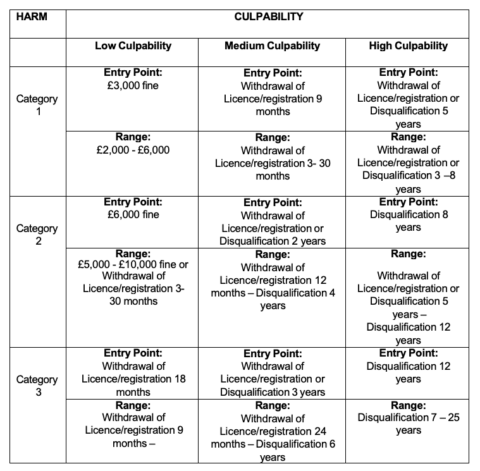
The new penalty structure will be as follows:
D: Horse Welfare and Management
(D)1 – Responsible Person failing to take all reasonable steps to ensure the safety and welfare of every horse in their care at all times:
British horseracing prides itself on demanding and ensuring that racehorses receive the best possible lifetime care. This is our moral and ethical duty to the racehorse. Achieving anything less than this is a major reputational risk to the sport and, more importantly, a risk to the racehorses our sport relies upon.
The standard of care expected of a Responsible Person, tasked with ensuring the safety and welfare of horses in their care having sought and accepted that responsibility through the BHA Licensing process, is a high one.
STAGE 1 – CULPABILITY
The Disciplinary Panel must assess the level of culpability of the Responsible Person by weighing up all the factors of the case.
Where there are characteristics present which fall under different levels of culpability the Panel should balance these characteristics to reach a fair assessment. Culpability is demonstrated by one of more of the following (non-exhaustive):
ASSESSMENT OF CULPABILITY
Low
- Behaviour that falls below the standard expected of a Responsible Person
- Single incident of very short duration
Medium
- Behaviour that falls far below the standard expected of a Responsible Person
- Behaviour that falls below the standard expected of a Responsible Person and occurs over a period of time, including but not limited to, unreasonable delays in seeking appropriate veterinary advice
- Neglect
- Very poor husbandry
High
- Cruelty
- Behaviour deliberately intended to cause significant harm
- Prolonged and/or repeated incidents or behaviour that might otherwise fall into medium level culpability.
STAGE 2 – HARM
The Disciplinary Panel must then assess the harm that has been caused to the horse(s). Where there are characteristics present which fall under different levels of harm the Panel should balance these characteristics to reach a fair assessment.
Harm is demonstrated by one or more of the following (non-exhaustive):
Category 1:
- No/little physical or developmental harm/suffering/distress to the horse(s)
- No ongoing/long-lasting issues/effects
Category 2:
- Moderate physical or developmental harm/suffering/distress caused to the horse(s)
- Ongoing/long-lasting issues/effects
Category 3:
- Very high level of physical or developmental harm/suffering/distress caused to the horse(s)
- Death (including injury/condition necessitating euthanasia)
NOTE: Where there was a real risk of more serious harm or long-lasting issues being caused to the horses(s) than actually resulted, the Panel should give serious consideration to an increase in categorisation.
STAGE 3 – STARTING POINT AND RANGE
Once the Panel has decided upon the levels of culpability and harm, they will then decide upon sanction. Each case should be considered on the basis of its factual circumstances and previous precedent is unlikely to be considered relevant.
Panels should start at the Entry Point and adjust for the mitigating and aggravating features they have found as part of their consideration of the evidence. At this stage the Panel can take into consideration further mitigating or aggravating features such as the Responsible Person’s personal mitigation, credit for cooperation with the BHA (if considered appropriate) or their previous history of disciplinary offences. This might necessitate a shift, either upwards or downwards within the range provided.