
Racing’s resilience: Making our industry more environmentally sustainable
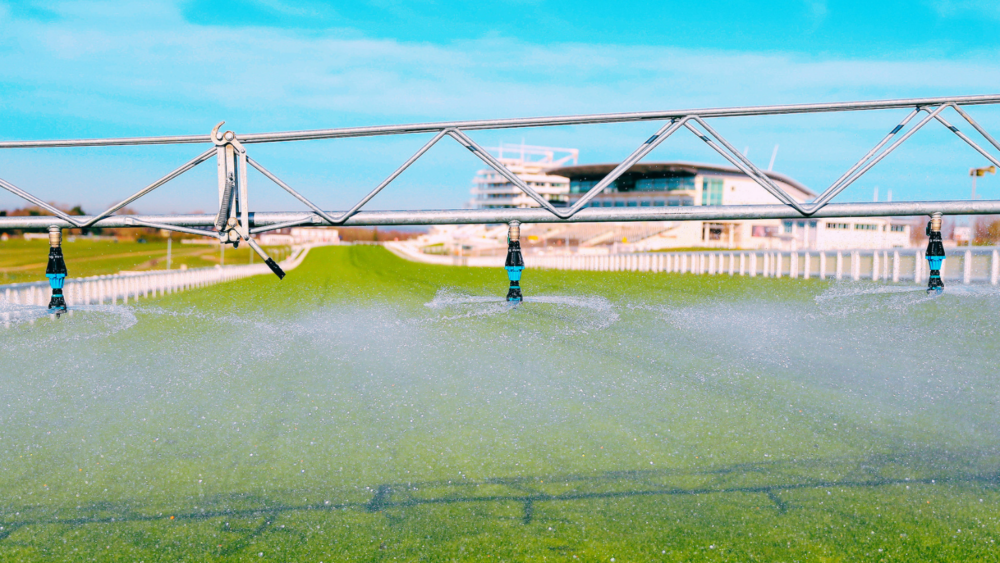
With the recent heatwaves bringing racing’s resilience into sharper focus, BHA Head of Environmental Sustainability Katie Carr provides an update on the practical action taking place to future-proof our industry against the challenges presented by a changing climate.
The weather is always a hot topic of conversation in British racing. 2025 was the warmest and sunniest year on record and this summer we’ve seen record-breaking temperatures and a prolonged period of dry weather.
The Met Office has warned that climate extremes are becoming the new norm, and the heatwaves we’ve experienced in recent years have certainly brought water resilience into much sharper focus.
From turf and gallop management to horse welfare, water is critical to our day-to-day operations. This means that the absence of recent rainfall is inevitably taking its toll.
Newmarket’s watered gallop has been partially closed to manage reservoir water levels, and the need for seemingly endless irrigation has upped the pressure on racecourse Clerks and their grounds teams.
We’ve seen in recent years that we are particularly susceptible to weather extremes. Since 2015 we have lost 285 fixtures due to weather-related ground conditions, with 40% of these abandonments occurring in the last three years alone.
And it’s not just hard ground that’s been the cause; we’ve also seen a substantial rise in the number of fixtures lost to waterlogging. Whether its drought or flooding, these are challenges we must meet head on.
Racing Resilient: A sustainable future
British racing’s continued success is intrinsically linked to the health of our natural environment.
 Last September, we took an important step by publishing Racing Resilient. This is the industry-agreed plan to safeguard our sport, horses and people against the effects of a changing climate.
Rooted in scientific evidence, the strategy builds on the positive work already underway to adapt our operations and harness new opportunities to tackle the environmental risks we face.
Like any strategy, its success depends on practical action. And from trainers investing in renewable technology to racecourses improving their water storage, a more sustainable approach to how racing operates is becoming the norm.
The green shoots of progress
Real progress can only be made if we have a clear understanding of how things look now, so that we can identify and measure where to make improvements.
We see so often that even the mention of climate change can feel overwhelming, especially when it comes to future-proofing businesses and operations. It can be difficult to know where to start.
So, a big part of the past year has been helping organisations and individuals build their knowledge and then supporting them with practical guidance.
A huge amount of work has already been done, particularly on racecourses, to understand how much water is needed, where it’s currently sourced and what needs to be done to future-proof supply.
We often view water in terms of the racing surfaces and care of horses, but it underpins almost every aspect of a racing business. From maintaining facilities and supporting staff and visitors, reliable access to water is part of day-to-day operations.
There are already management systems at racecourses to help conserve water use, while some are embracing solutions like rainwater harvesting to collect, store and use water that would otherwise flow into drains.

The Thoroughbred Carbon Calculator is now available to studs and the racehorse training community
Every racing business will face different issues, often influenced by regional and geographic factors. How we manage water supply and demand will vary across the country: from the traditionally wetter north-west to the more water-stressed eastern regions.
The most effective response is a balanced approach, which helps organisations understand their own position and identity the most appropriate interventions according to whether their challenges are related to drought, flooding or indeed both.
A similar approach has been taken on carbon emissions. With funding from the Racing Foundation, more than 75% of racecourses have been supported to establish their carbon footprint – the total amount of greenhouse gases generated by their activity.
More are set to complete this work soon, and all British racecourses now have access to a carbon calculator that allows them to gather accurate data to inform their emission efforts.
The Thoroughbred Breeders’ Association launched its own stud farm carbon calculator in 2023 – believed to be the first developed specifically for use in the equine sector.
The tool calculates emissions across key areas of a breeding operation, including land and energy use, feed and bedding, manure management and horse transportation, and also offers solutions for reducing environmental impact.
Building on the success of the stud farm carbon calculator, we have now adapted and expanded the tool so that it is also available to the racehorse training community. The calculator helps yards better understand their carbon footprint, identify the main sources of emissions, and make informed decisions to improve business sustainability.
To provide further support, Carbon Literacy training for those in environmental roles across the industry has then helped to equip people to lead change within their own organisations – and this is something we will continue to deliver.
Resilience in action
What’s particularly encouraging is that we have seen several examples of new initiatives and tangible progress over the past year alone.
Ascot Racecourse has completed one of the largest rooftop solar installations across UK sport, with 1,200 new solar panels expected to generate approximately 9% of the racecourse’s electricity needs.
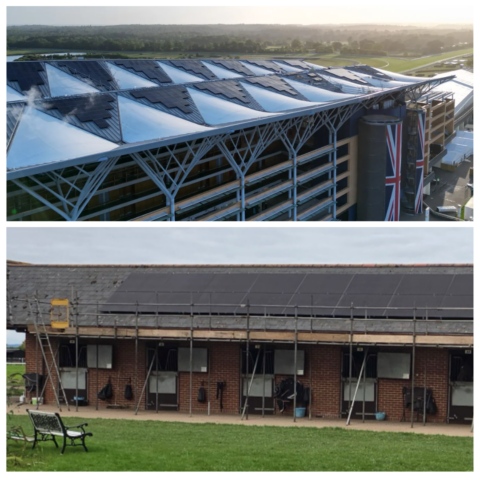
Ascot Racecourse and Gary and Josh Moore Racing have both installed solar panels
The team at Gary and Josh Moore Racing have taken similar steps to reduce their costs and improve energy resilience by installing solar panels at their Cisswood Stables – with investment in energy efficiency powering long-term term business planning.
New technologies are offering businesses increasingly more cost-effective ways to make a positive impact. Simple measures really can make a meaningful difference.
The British Racing School’s summer showcase was powered by a hydrogen generator rather than a conventional diesel or HVO equivalent. The generator produced reliable renewable energy and operated silently, which created a more relaxed environment for horses, riders and spectators.
And at Newton Abbot they’ve installed waterless urinals. This is a perfect example of using the latest technology to reduce water dependency and work in a more efficient, environmentally friendly and cost-effective way – while of course maintaining hygiene standards. The saving: approximately two million litres of water and £9,660 every year.
Not every sustainability success story needs to involve major infrastructure investment. Every action helps our industry become more resilient.
Custodians of the land
What’s been clear throughout this work is the recognition of our shared responsibility to protect and promote the natural environment. It is partly pragmatic, of course. The breeding, training and racing of horses rely on creating the optimum conditions for our equine athletes to thrive.
But as major landowners who manage thousands of acres of grassland, woodland and hedgerows, there’s also an overwhelming sense of what we can do to support our habitats to flourish. We’ve certainly seen more sustained interest in using racing’s estates to contribute towards local and national nature recovery.
Last year, Jockey Club Estates planted 17,800 trees and six miles of hedgerow in Newmarket through its forestry and conservation programme. The benefits of this are numerous: trees capture and store carbon and hedgerows provide vital habitats for various species of birds and insects.
What’s more, timber harvested from the estate is chipped down to create biomass fuel for the British Racing School, Jockey Club Rooms and National Horseracing Museum – a perfect illustration of interconnected solutions to reducing emissions and enhancing sustainability.
Sharing knowledge and best practice
There are many pockets of excellence and worthwhile activity across our industry. This is vital to making progress, but no single organisation can tackle our shared environmental challenges alone.
British racing has established itself as one of the leading jurisdictions in this space, mainly because we are approaching things in an increasingly collaborative and evidence-based way.
Our environmental action group has helped us improve how we coordinate efforts across the sport. Racing Foundation funding has allowed us to form partnerships with environmental experts and develop new ideas, including potential commercial opportunities to help sustain our sport and our global reputation.

In 2025, Jockey Club Estates planted 17,800 trees and six miles of hedgerow in Newmarket
And this work is attracting significant interest from other racing authorities.
Our momentum has contributed to global action – again, recognising that climate change, water security and environmental resilience transcend national borders.
The International Federation of Horseracing Authorities (IFHA) recently held its first ever Climate Change and Sustainability Summit. Britain has played a leading role in shaping this programme, with BHA chief executive officer Brant Dunshea chairing the IFHA’s Sustainability Committee.
It’s important that British racing leads globally and is seen as a source of expertise and action. What’s also crucial is that we learn from others and identify new and innovative ways to deliver improvements on our shores.
What’s next?
Thanks to a monumental effort from racecourses, breeders, training yards, businesses, charities and so many others, we have established strong foundations for growth and started to accelerate progress in key areas.
Businesses are reviewing purchasing decisions, reducing unnecessary waste and considering environmental impacts as part of routine operational planning. They are thinking more sustainably, both in terms of their own organisations and the industry more generally.
Water resilience remains high on the agenda, as does future proofing our sport against extreme weather at the other end of the spectrum. It won’t be long until we are managing the impact of rainfall, waterlogging and deep freezes. Again, there is valuable work underway in this space to protect our operations.
It’s so often the case that those with the desire to make progress lack the means or the support. An immediate priority is to develop more practical tools and expert guidance through a central industry resource to share examples of best practice and learning, so that we are supporting everyone to make more sustainable choices.
The environmental sustainability of British racing is already becoming part of everyday decision-making. There’s still much more to do, but the momentum is growing and we’re seeing practical action that can help protect the sport and safeguard our long-term future.
If you’re interested in learning more, please get in touch: [email protected].